
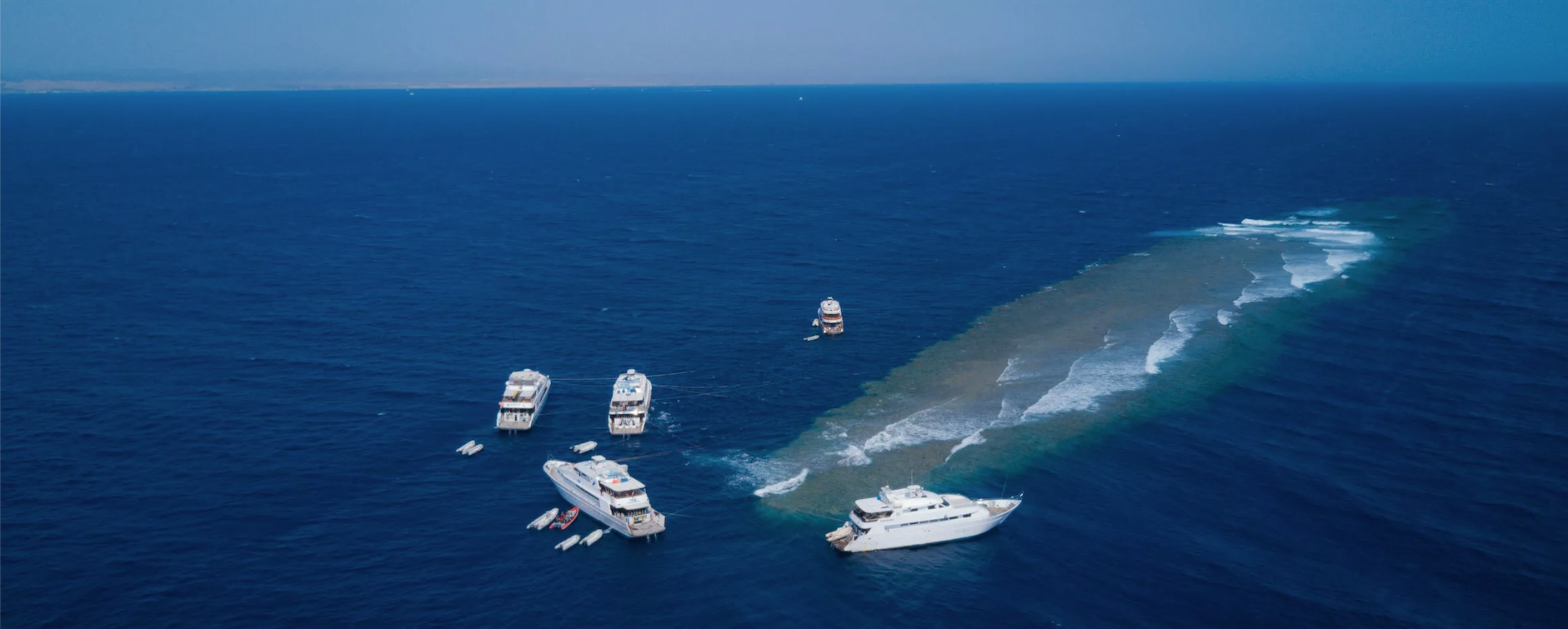
Elphinstone Reef
An offshore pinnacle famous for oceanic whitetip shark encounters and sheer walls dropping into the deep blue.
Quick Facts
Quick Facts
Location
Offshore, near Marsa Alam
Access
Boat only, from Marsa Alam area
Recreational Depth
Approximately 20–40 m
Technical / Structural Depth
Beyond 40 m (technical)
Experience
Advanced
Current
Moderate to strong, variable
Visibility
Typically around 20–40 m
Famous For
Oceanic whitetips, hammerheads and pelagic encounters
Why Dive This Site?
Why Dive This Site?
Offshore Pelagics
Open-ocean pelagic species gather in the blue water around the reef and plateaus.
Oceanic Whitetip Sharks
Elphinstone is one of the Red Sea’s most important sites for oceanic whitetip shark encounters, especially in autumn.
Vertical Walls
Sheer walls drop on both sides of the reef, plunging well beyond recreational diving limits.
Advanced Drift Diving
A drift dive requiring advanced certification, comfort in current, and blue-water experience.
The Dive Site
Elphinstone Reef
Depth
20–40 m recreational; deeper structural walls beyond recreational limits
Dive Level
Advanced — Drift Dive
Conditions & Currents
Moderate to strong, variable currents. Visibility typically around 20–40 m, depending on conditions. Best dived early morning.
Dive Description
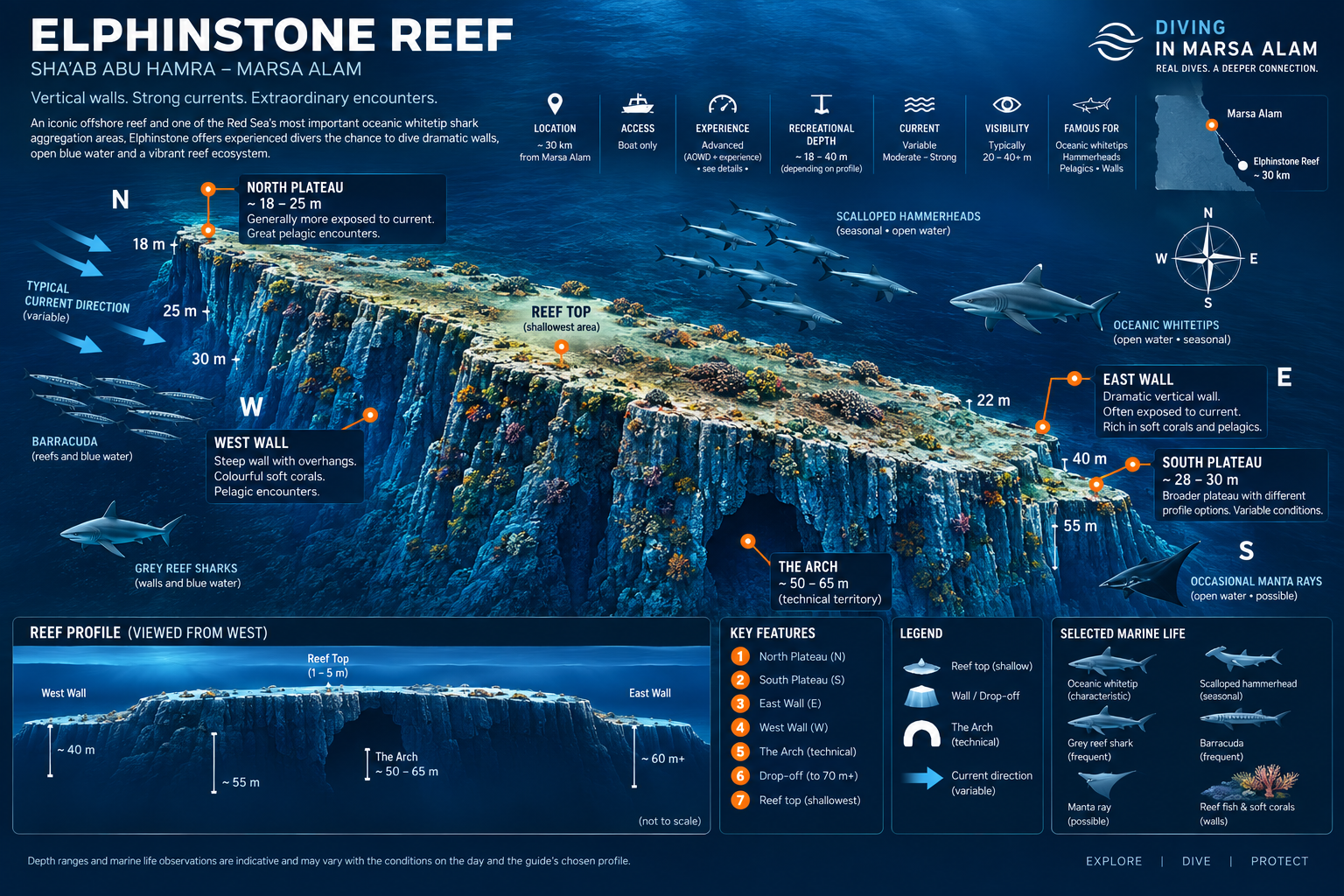
Elphinstone is an offshore reef shaped like a cigar, oriented roughly north-south, with sheer walls dropping on both the east and west sides. The reef crest rises close to the surface, while the northern and southern plateaus extend outward at greater depths, with the walls plunging well beyond recreational diving limits. These two plateaus are the primary observation points for pelagic species. The reef is small enough to dive in a single drift, but large enough that conditions and marine life vary considerably between the two ends.
Location & How to Get There
Elphinstone is an offshore reef accessed by boat from the Marsa Alam area. Travel time depends on departure port, boat, and conditions. Day boats and liveaboards both visit the site.
Elphinstone Reef
Open in Google MapsDive Map
The right profile at Elphinstone is dictated by the conditions on the day, not by a fixed route. This map is a simplified representation, not a fixed route. The actual route and profile depend on conditions and the guide’s judgement.
Site-Specific Features
Site-Specific Features
North vs South Plateau
The north and south plateaus are the two focal points of every Elphinstone dive, but they are not simply "hard" and "easy" versions of the same thing. Both plateaus can experience significant currents, and the appropriate route depends entirely on the conditions on the day. Hammerheads may be encountered around the northern plateau, while oceanic whitetips are often associated with the southern end and the surrounding blue water — but neither encounter is guaranteed. Conditions change substantially from day to day depending on wind, current direction, and sea state. Guides choose the profile based on the conditions on the day, not on a fixed route. Both plateaus can produce exceptional encounters; neither should be dismissed as the "easier" or "harder" option without considering the specific conditions.
The Arch
The Arch is a tunnel-like formation at the southern end of Elphinstone Reef, approximately 50–65 m deep, with exact depths varying between descriptions. It lies well beyond recreational diving limits and requires appropriate technical training, equipment and gas planning. It is not a normal recreational dive feature and should not be treated as one. The exact depth of The Arch should be confirmed from authoritative sources before any dive plan is made.
Oceanic Whitetip Sharks
Elphinstone is one of the most important sites in the Red Sea for oceanic whitetip shark encounters. These pelagic sharks are frequently associated with the reef, particularly during the September–December period, with October and November often particularly favourable. Oceanic whitetips are open-ocean sharks that approach reefs to investigate and patrol. They are naturally curious and may approach divers closely. Responsible observation means maintaining a calm, vertical position, keeping the shark in view, and allowing the animal to approach on its own terms. Wildlife encounters can never be guaranteed — these are wild animals in their natural habitat.
View Marine Life PageWildlife encounters can never be guaranteed. These are wild animals in their natural habitat.
Hammerheads & Other Pelagics
Hammerhead sharks can be encountered around Elphinstone, particularly in favourable seasonal conditions, but encounters are less predictable than the site’s reputation might suggest. Encounters tend to occur in the blue water off the walls and plateaus, with distance and behaviour highly variable. Other pelagic species that may be observed include grey reef sharks, trevally, barracuda, and occasionally thresher sharks. The open-ocean environment of Elphinstone makes it a genuine pelagic dive site — the walls drop into deep water, and the blue adjacent to the reef is the habitat of these species.
View Marine Life PageDive Profiles
Dive Profiles
North Plateau Drift
Depth Range
Indicative 25–40 m
Reef Zone
North plateau and adjacent wall
What to Expect
A drift along the wall leading to the northern plateau, where the reef extends outward at depth. The plateau area is the primary zone for pelagic observations.
Current Considerations
Both plateaus can experience significant currents. Entry point, route and exit depend on current, conditions, gas and the guide’s assessment on the day.
Marine Life Focus
Possible encounters: oceanic whitetips, hammerheads, grey reef sharks, pelagic fish in the blue.
Experience Implications
Advanced. Requires comfort with drift diving, depth management, and blue-water safety stops.
South Plateau Drift
Depth Range
Indicative 20–35 m
Reef Zone
South plateau and adjacent wall
What to Expect
A drift along the wall to the southern plateau, which often extends at a shallower depth than the north. The plateau is a known gathering area for pelagic species.
Current Considerations
Currents here can be significant. Entry point, route and exit depend on current, conditions, gas and the guide’s assessment on the day.
Marine Life Focus
Possible encounters: oceanic whitetips, hammerheads, grey reef sharks, schools of trevally and barracuda.
Experience Implications
Advanced. Requires drift diving experience and comfort in open water.
Wall Drift (East or West)
Depth Range
Indicative 20–40 m
Reef Zone
East or west wall
What to Expect
A drift along one of the sheer walls, keeping the reef to one side. The focus is on wall life and blue-water pelagic observations.
Current Considerations
Current direction determines which wall is dived. The section of wall covered depends on current, conditions, gas and the guide’s assessment — it does not need to cover the reef’s entire length.
Marine Life Focus
Soft corals, whip corals, reef fish along the wall; possible pelagic species in the adjacent blue.
Experience Implications
Advanced. Long drift in open ocean; requires gas management and SMB deployment for pickup.
Conditions & Currents
Elphinstone is an exposed offshore reef, and currents here are variable — they can range from mild to strong, and their direction can shift during a dive. The practical consequence is that the right profile is dictated by the conditions on the day, not by a fixed route. Current strength and direction determine which wall is dived, where the group enters the water, and where the boat picks up. Guides assess conditions at the surface and underwater before committing to a route. Divers should be prepared for current at any time and should carry a surface marker buoy.
Who Is This Site For?
Elphinstone is for advanced divers. The combination of depth, current, and open-ocean exposure means it is not suitable for beginners or newly certified Open Water divers. Divers should be comfortable with drift diving, depth management, and blue-water conditions. Some operators require a minimum certification of Advanced Open Water and a minimum number of logged dives — these requirements vary by operator and should be confirmed at the time of booking.
Technical Diving
Elphinstone also has deeper structural features that extend beyond normal recreational profiles. Technical divers may explore deeper sections under appropriate training, equipment, gas planning and conditions. The Arch, at the southern end of the reef at approximately 50–65 m, is a deeper feature that should only be attempted by divers with appropriate technical diving certifications, equipment and gas planning.
View CoursesMarine Life
Elphinstone Reef
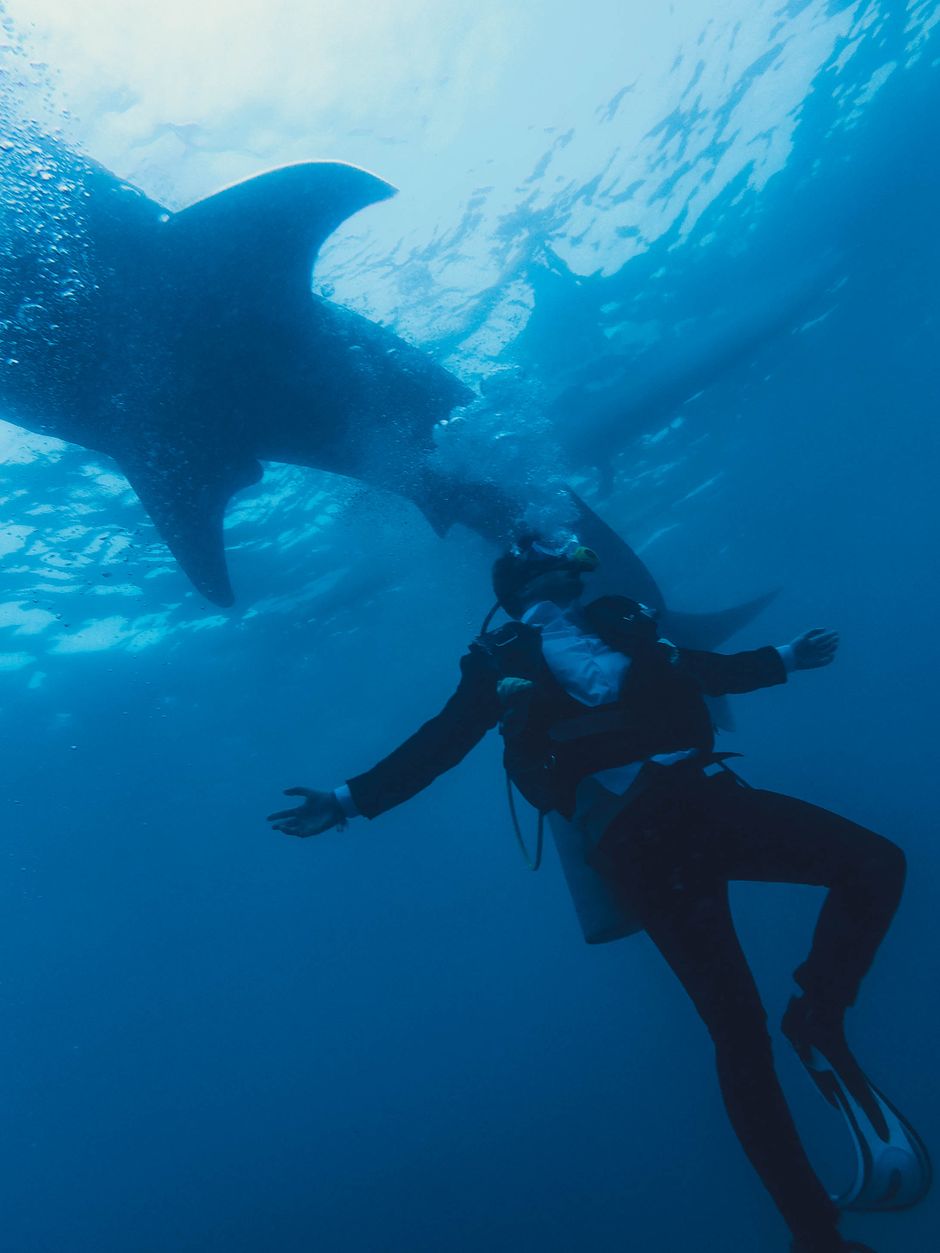
Sharks
Oceanic white-tips at Elphinstone, hammerheads in the Deep South, and grey reef sharks on the offshore pinnacles.
Turtles
Turtles may be encountered around the shallow reef and surrounding areas.
Tuna
Pelagic tuna may be encountered in the blue water near offshore reefs and plateaus.
Barracuda
Barracuda may be encountered in the blue water near offshore reefs and walls.
Oceanic Whitetip Shark
Characteristic
Hammerhead Sharks
Seasonal
reef-sharks
Possible
Grey Reef Shark
Possible
Turtles
Possible
Tuna
Possible
Barracuda
Possible
Wildlife encounters can never be guaranteed. These are wild animals in their natural habitat.
When to Dive
Elphinstone is a spectacular dive site year-round, and pelagic encounters remain possible outside the strongest seasonal windows. The seasonal periods indicate when conditions and observations may offer better chances — not a guarantee of encounters. For oceanic whitetip sharks, September through December can be presented as an important seasonal window, with October and November often particularly favourable based on available observations. Hammerhead encounters are less predictable, though June through August can be presented as an indicative seasonal window at Elphinstone. Water temperatures range from approximately 22°C in winter to 30°C in summer, with visibility typically around 20–40 m depending on conditions.
Underwater Photography
A fisheye or very wide-angle lens is the most appropriate choice for Elphinstone. The dramatic vertical walls, the large underwater environment, the open blue-water setting, and the possibility of large pelagic animals approaching close to divers all favour extreme wide-angle photography. Standard wide-angle lenses can work, but a fisheye gives the best results when the subject is large and close.
Oceanic whitetip sharks are naturally curious and may approach divers, sometimes to within close range. This behaviour creates some of the best wide-angle and fisheye opportunities in the Red Sea — but encounters are never guaranteed, and the shark determines the distance. The photographer’s job is to be ready, not to chase.
Hammerheads may be encountered in open water around the reef and plateaus, particularly in favourable seasonal conditions. A wide-angle or fisheye setup is the right choice when they appear, but sightings are not predictable, and the distance at which they pass is highly variable. Do not assume close passes; be prepared for brief, distant encounters.
Practical technique matters as much as lens choice. Maintain excellent buoyancy at all times — the reef wall is your reference, but never touch it. Position yourself so you can watch the blue while keeping the wall in your peripheral vision. Let the animal determine the distance; never swim after it. Keep the camera stable; smooth, controlled movements produce sharper images than rapid panning. Use strobes carefully — in open blue water, natural light is often more effective than strobe, and strobe placement matters when the subject is close. Avoid firing strobes directly into the face of an approaching animal. Stay clear of the reef, avoid contact with corals, and do not disturb or block any marine life. The goal is to photograph behaviour as it unfolds naturally.
Safety & Practical Information
Elphinstone is an offshore dive accessed by boat from the Marsa Alam area. Travel time depends on departure port, boat, and conditions. Divers should carry a surface marker buoy (SMB) and know how to deploy it. A dive computer is essential for depth and gas management. Dives are conducted according to the procedures and requirements of the dive operator, and the guide selects the route based on conditions on the day. Divers should be prepared for current and should be comfortable with blue-water safety stops away from the reef. Surface conditions can be choppy. Appropriate experience and certification are required — confirm specific requirements with your operator at the time of booking.
Planning your visit
Boat access only
Minimum certification: Advanced Open Water
Recommended: surface marker buoy
Best time: 06:00–09:00
Nearest port: Marsa Alam Marina
Boat transfer: varies by port and conditions
Surface conditions: can be choppy
Recommended experience: advanced with drift diving experience
Gallery
Elphinstone Reef
FAQ
Elphinstone Reef
No. Due to depth, currents, and the open-ocean environment, Elphinstone is recommended for advanced divers with experience in drift diving.
Prices
Clear, honest diving prices
No hidden costs. Daily diving, packages, courses, and private options — all in one place.
View Diving PricesReady to dive Elphinstone Reef?
An offshore pinnacle famous for oceanic whitetip shark encounters and sheer walls dropping into the deep blue.
Enquire About This Dive